LEXINGTON, Va. –The Washington and Lee University administration is unsure of how it will proceed following a bill changing the age limit for tobacco and nicotine products, said the university’s Director of Health Promotion Jan Kaufman.
Virginia recently joined seven other states in raising the minimum age to purchase and possess tobacco, nicotine and alternative nicotine products from 18 to 21 years old.
Administrators at Washington and Lee were surprised to see the word possession included in the bill, said Kaufman.
“Right now, the university policy says no use of tobacco products, which includes e-cigarettes, in any residence hall and classroom buildings on campus, but walking outside you could be using any tobacco product,” said Kaufman. “You could possess any of those products in your residence hall right now if you were under 21, but if you weren’t using it right now, it wouldn’t be a violation of university policy.”
According to current university policy, any person found smoking in or near residence halls will be fined $250.
Kaufman said that Juul products are popular among students and can be hard to detect, so she’s still not sure how the school is going to enforce the law, but knows Public Safety will need to be involved.
At least half of the student population at Washington and Lee is under 21 at any given time, so Kaufman says it’s important to educate students and change policies sooner rather than later. Kaufman, Vice President of Student Affairs and Dean of Students Sidney Evan and Director of Student Health and Counseling Services Dr. Jane Horton will all be working together to formulate a plan.
“We know we need to address it and we’ve brought it to the attention of res life, it’s on Dean Evans’ radar, and it’s been brought to the attention of the university attorney,” she said. “Dean Evans said we would address it this summer, but Dr. Horton and I said we think that conversation probably should happen a little earlier.”
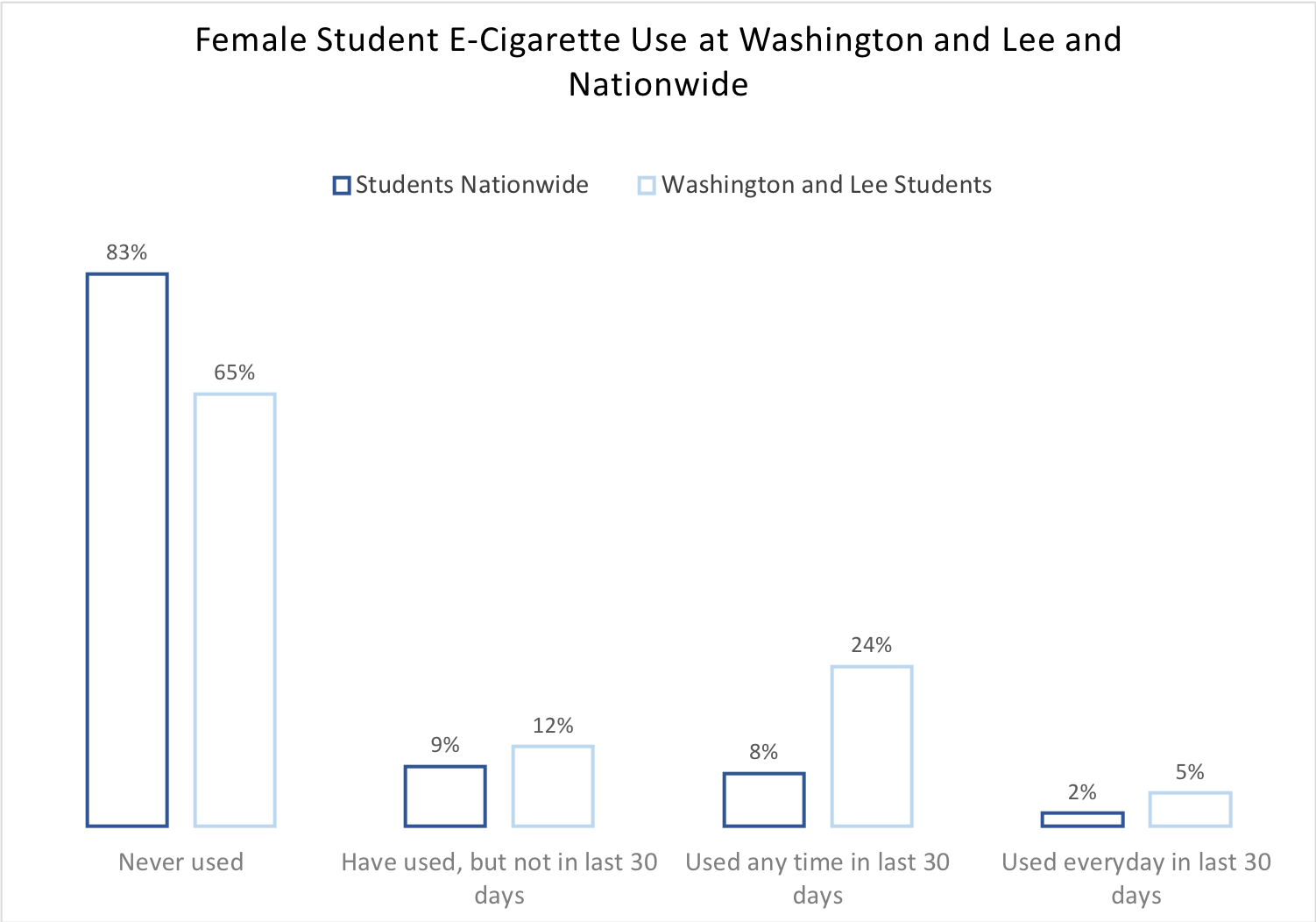
The results from the American College Health Association’s spring 2018 National College Health Assessment survey show that Washington and Lee students use e-cigarettes more frequently than the national average. According to the survey results, 15 percent of males and eight percent of females nationwide said they had used an e-cigarette in the last 30 days, compared to Washington and Lee where 39 percent of males and 24 percent of females said the same.

Washington and Lee first-year Andrew Harris said he wishes the law had been changed sooner.
“Nicotine is more addictive than alcohol, second only to heroin. I think changing the age limit to 21 is great because it makes it more difficult for minors, the most susceptible group to addiction, to acquire a Juul or any e-cig,” said Harris. “Personally, I wish I hadn’t ever been able to get [a Juul] at 18 but I’m working on quitting.”
The goal of the bill is to prevent teens and young adults from gaining access to nicotine and tobacco products from their peers and forming addictions.
Washington and Lee sophomore Owen Hadden opposes the bill.
“At this point, when you’re 18,” said Hadden, “you should be able to make your own decisions and control your own usage of Juul products.”
Kaufman said that if the laws were made on the basis of science the purchasing age for alcohol and tobacco products should be 25, when the brain is done developing.
“It’s not like you have to be doing it for years and years to become addicted, that window for addiction is so high,” she said, “especially when the brain is still developing, which would include college students as well, that is the biggest health concern, the addiction.”
Virginia Governor Ralph Northam signed HB 2748 on February 21 and it will go into effect on July 1 of this year.
 Annie Echols